

Waking up with that familiar, dull ache? The taste of regret in your mouth? Yeah, I've been there. A hundred times. Maybe more. You're not alone. The weekend got away from you, and now you're looking at the damage, wondering how to even start fixing it. But here's the honest truth: you can claw back up to 3000 calories in just 5 days with a solid, smart recovery plan. No crash diets, no judgment, just smart recovery.
Understanding the Calorie Blowout
Let's not sugarcoat it: a heavy drinking spree is a calorie surplus waiting to happen. It's not just the alcohol itself, though those liquid calories add up fast. A typical pint of standard beer packs around 150 calories, and a glass of wine, say 175ml, is about 160 calories. So, six beers? That's 900 calories before you even think about food.
And that's where the real damage often occurs. Alcohol lowers inhibitions, messes with your judgment, and suddenly that late-night pizza or greasy diner breakfast seems like a brilliant idea. People often report consuming an extra 1000-2000 calories in unplanned, high-fat, high-carb foods during and after a night of heavy drinking. My own experience, and what I hear from countless people, is that a weekend blowout can easily stack up an extra 2500 to 3000 calories beyond your usual intake. This calorie surplus isn't just a number; it's why you feel sluggish, bloated, and generally off.
Beyond the sheer caloric intake, a lot of what you're feeling and seeing on the scale is water weight and dehydration. Alcohol is a diuretic, meaning it makes you pee more, leading to fluid loss. Your body then tries to hold onto any water it can, causing that puffy, bloated feeling.
Hangovers are largely a result of dehydration, and replenishing fluids is key to easing recovery. You can also blame inflammation and disrupted sleep, which throw your whole system out of whack.
Don't panic about the scale, though. A 2-5 pound weight gain after a big night out is almost certainly not pure fat. It's mostly water, some undigested food, and inflammation. The goal isn't to lose those pounds overnight, but to normalize your system and get back to your baseline.
Day 1-2: Hydration and Electrolyte Balance
The first 48 hours are all about hitting the reset button on your system. Forget punishing workouts or extreme deprivation. Your body is screaming for one thing: fluids. Alcohol contributes to dehydration, so replenishing fluids is priority one.
Aim for at least 8-10 glasses of water per day. That's about 2-2.5 liters. And don't just chug it; sip it steadily throughout the day. Add a pinch of sea salt or a slice of lemon to some of your water for a natural electrolyte boost. Your body lost a lot more than just water; it lost vital minerals.
Electrolyte-rich foods are your best friend right now. Think bananas, which pack about 422mg of potassium per medium fruit. Avocados are even better, offering around 485mg of potassium per 100g. Reach for fresh fruit over sugary fixes to avoid prolonging blood sugar disruption. Coconut water is another great option, with about 250mg of sodium and 600mg of potassium per 16oz serving, but watch for added sugars.

My go-to on a Monday morning? A big glass of water with a lemon wedge, followed by a simple breakfast. We're talking plain Fage Total 0% Greek yogurt, which delivers 18g of protein per 150g serving, mixed with a sliced banana. If you're really feeling it, add a tablespoon of chia seeds for some fiber. This stabilizes your blood sugar without overwhelming your digestive system. For more gentle recovery ideas, check out My Monday (Morning After) on the Town: A 24-Hour Crash Diet Plan to Salvage a Big Night.
Comparison of Hangover Foods
When you're hungover, your body craves simple carbs and sugar. It's a primal scream for energy because alcohol messes with your blood sugar and depletes your glycogen stores. Pimenta et al. (1994) highlighted how glycogen contributes to hepatic glucose output [2]. Alcohol consumption can interfere with this process, leading to low blood sugar and fatigue, which is why your brain screams for quick energy. But giving in to those cravings for highly processed junk can actually make you feel worse in the long run.
Hangovers commonly result from dehydration, disrupted sleep, inflammation, and alcohol metabolism byproducts. Effective relief targets these underlying causes. So, while a sugary pastry might give you a temporary lift, it's followed by a crash. You need foods that provide sustained energy and help replenish nutrients, not just spike your blood sugar.
Let's look at some common "hangover foods" and see how they stack up.
| Food Item | Calories (per 100g) | Protein (g) | Fat (g) | Carbs (g) | Fiber (g) | My Take |
|---|---|---|---|---|---|---|
| Yogurt Bnine BANANA, Jaouda | 88 | 4 | 2 | 14 | 0 | Good for a light, digestible start. |
| Gerble - Organic Chocolate Cookie w/ Banana | 459 | 9 | 19 | 59 | 8 | Skip this. Too much sugar and fat for recovery. |
| Avoine chocolat, Bjorg | 454 | 8 | 18 | 61 | 8 | Another sugar bomb. Avoid. |
| Avoine complete, Bjorg | 442 | 9 | 15 | 64 | 8 | Better fiber, but still high in carbs. Choose plain oatmeal instead. |
As you can see, those "organic" or "healthy-sounding" options can still be loaded with calories, fat, and sugar. The Gerble cookie, for instance, has 459 calories and 59g of carbs per 100g. That's not recovery fuel; that's setting yourself up for another crash.
Instead, lean into fresh fruits and lean proteins. Fruit juice can provide instant energy from fructose, but whole fruit is always better for the fiber. A big bowl of oatmeal (plain, not the sugary packets) with berries and a little protein powder is far superior. Eggs are fantastic: 6g of protein per large egg, plus choline to support liver function. A light broth-based soup with some lean chicken and veggies is also a winner. For quick, decent options, check out 'Shit' Meals to Actually Fuel Your Body: 10 Fast Food Options Under 500 Calories (That Don't Suck).
Day 3-5: Nutrition and Portion Control
By day three, the worst of the hangover should be gone, and you're ready to shift focus from immediate recovery to calorie clawback. Remember that 2500-3000 calorie surplus? We're going to tackle it systematically, without starving yourself.
The simplest way to create a calorie deficit is to reduce your intake by a manageable amount each day. Aim for a 500-calorie deficit per day. Over three days, that's 1500 calories. Combine that with the subtle reductions you naturally make on Day 1-2 (swapping greasy food for fruit, skipping alcohol entirely), and you're well on your way to offsetting the blowout. Creating a consistent calorie deficit is key for weight loss and preventing regain.
For recovery, focusing on lean protein and complex carbs is smarter. This isn't about eating less; it's about eating smarter. Choose nutrient-dense foods that keep you full on fewer calories.
Here are some examples of portion-controlled meals that are great for Days 3-5:
| Meal Item | Calories (per 100g) | Protein (g) | Fat (g) | Carbs (g) | Fiber (g) | My Take |
|---|---|---|---|---|---|---|
| Grilled Chicken Marsala, Healthy Choice | 64 | 17 | 3 | 21 | 4 | Excellent protein-to-calorie ratio. Filling. |
| Grilled Rosemary Boneless Chicken Breast, Trader Joe's | 229 | 10 | 3 | 19 | 1 | Good protein, but watch portion size. |
Let's break down the Grilled Chicken Marsala. At 64 calories per 100g, and with 17g of protein, this is a phenomenal option. A standard serving of 300g would give you 192 calories and 51g of protein. That's serious satiety for very few calories. Pair it with a huge serving of non-starchy vegetables like broccoli or spinach, which are incredibly low in calories and high in fiber.
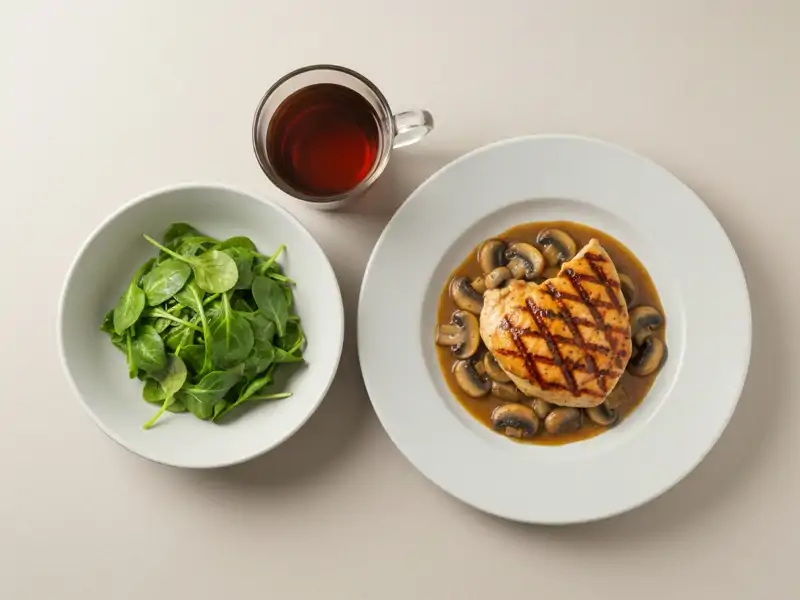
The Trader Joe's Grilled Rosemary Boneless Chicken Breast is also good, but at 229 calories per 100g, you need to be more mindful of your portion size. A 100g serving is probably fine, but if you eat the whole package, you're looking at a much higher calorie count. Pair it with a big salad (dressing on the side, please!) or steamed veggies. For more ideas on how to eat out smartly without blowing your deficit, see 10 Restaurant Myths Demolished: Low-Cal, High-Taste Options Revealed.
Consider adopting some time-restricted eating principles during these days. Andriessen et al. (2022) found that three weeks of time-restricted eating improved glucose homeostasis in adults with type 2 diabetes [3]. While you're not trying to treat diabetes, the principle of a longer fasting window can help control total daily calorie intake. For example, delaying your first meal until 10 or 11 AM, or finishing dinner by 7 PM, creates a natural deficit window without feeling like you're "skipping" meals.
This isn't about deprivation. It's about making deliberate choices. Opt for lean protein at every meal - chicken breast, fish, tofu, egg whites. Load up on non-starchy vegetables. Choose whole grains like quinoa or brown rice in measured portions. Cut out sugary drinks entirely, and stick to water, black coffee, or unsweetened tea. For those sweet cravings that inevitably pop up, check out Monday Recovery: 5 Desserts to Help You Regain Control After a Sweet-Filled Weekend for smart options.
The guilt is often more damaging than the actual calories. Don't let one bad weekend derail your entire week, or worse, your long-term goals. Acknowledge what happened, implement this plan, and move on. You're not starting over; you're just course-correcting.
Get back on track with a personalized meal plan and start recovery today.