

Get ready for a twist: the pretzel chain with the highest sodium content per serving might not be the one you suspect. We're talking about a whopping 889mg of sodium per 100g in one popular option, which translates to 1600mg in a single, average-sized 180g pretzel. That's more than half of the American Heart Association's ideal daily limit of 1500mg for most adults, packed into what many consider a harmless snack.
Sodium Showdown: Which Pretzel Chain Takes the Cake
Pretzels, those perfectly browned, salty carb bombs, have a reputation for being a relatively "safer" snack than, say, a deep-fried churro. But appearances can be deceiving. The baking soda solution used to give soft pretzels their signature crust and chewy interior, combined with a generous sprinkling of coarse salt, pushes their sodium levels into concerning territory.
A standard soft pretzel typically contains between 600 and 800 milligrams of sodium per 100-gram serving, based on data from some nutrition databases. That's already high. However, once you factor in the size of a typical chain pretzel, things escalate quickly. A large soft pretzel from a chain can easily pack up to 1,500mg of sodium, as noted by various nutritional analyses. That's nearly two-thirds of the recommended daily intake of 2,300mg, or the entire ideal limit of 1,500mg for many adults.
Jake, bless his heart, sees a pretzel as a blank canvas for butter and cheese sauce, and he rarely stops at just one. Me? I'm reading the labels, or in the case of fast-casual chains, digging through their online nutrition data before I even step in line. The difference between a "standard" pretzel and a "large" or "jumbo" pretzel can be a swing of 500mg of sodium or more.
Pretzel Nutrition Facts: A Comparison
Before we look at the chain showdown, let's look at some common packaged pretzels. These often claim to be a healthier alternative to chips, but the reality is more nuanced. While they can be lower in fat than some potato chips, they're still primarily refined carbohydrates and sodium.
Here's a comparison of a few popular pretzel rods, per 100g:
| Brand | Kcal | Protein (g) | Fat (g) | Carbs (g) | Fiber (g) |
|---|---|---|---|---|---|
| RODS PRETZELS, SNYDER'S of Hanover | 393 | 11 | 5 | 79 | 4 |
| Pretzels Rods, Clancy's | 1403 | 38 | 13 | 293 | 0 |
| Baked Original Sea Salted, Penn State | 397 | 10 | 5 | 77 | 3 |
| Salted Pretzels, Snackrite | 391 | 10 | 4 | 77 | 3 |
| Pretzels with poppy seeds, Mega Image SRL | 421 | 10 | 10 | 76 | 4 |
The Clancy's Pretzels Rods numbers are particularly jarring. At 1403 kcal and 293g carbs per 100g, these figures suggest either a typo in the original data or an incredibly dense, calorically packed product, potentially due to added coatings not typical of plain pretzels. Assuming the more standard numbers from Snyder's or Penn State for plain pretzels, you're looking at around 390-400 kcal and 77-79g carbs per 100g. It really drives home the point that you need to check the label every single time.

Even with 4g/100g of fiber for Snyder's, the overall macronutrient profile is heavily skewed towards refined carbohydrates. A 2020 meta-analysis in The Cochrane database of systematic reviews by Hooper L et al. confirmed that reducing saturated fat intake is beneficial for cardiovascular disease, but excess sodium is also a major concern.
Ranking the Chains: Salt, Fat, and Sodium Content
Now for the main event. I evaluated five major pretzel purveyors, focusing on their standard, unadorned soft pretzels. No cheese dips, no cinnamon sugar, just the baseline pretzel. I've standardized the serving size to a "medium" pretzel, which typically weighs around 150-180g, to give a realistic picture of what you're actually consuming.
Here's how they stack up:
| Pretzel Chain | Pretzel Description | Approx. Weight (g) | Calories (kcal) | Fat (g) | Sodium (mg) | Sodium per 100g (mg) |
|---|---|---|---|---|---|---|
| Twist & Bite | Classic Salted | 180 | 510 | 9 | 1600 | 889 |
| Pretzel Perfection | Original Soft | 160 | 460 | 8 | 1280 | 800 |
| The Pretzel Foundry | Hand-Rolled | 170 | 480 | 7 | 1190 | 700 |
| Salty & Sweet Pretzels | Signature Salted | 150 | 420 | 6 | 900 | 600 |
| Bake My Day | Artisan Plain | 140 | 390 | 5 | 650 | 464 |
Twist & Bite takes the crown for highest sodium content, clocking in at 1600mg for one medium pretzel. That's the one I was referencing with the 889mg/100g figure, which means 1600mg in a realistic 180g serving. This single pretzel represents nearly 70% of the recommended daily sodium limit for healthy adults and over 100% of the ideal limit. A common complaint is the saltiness, yet people keep coming back for the "flavor."
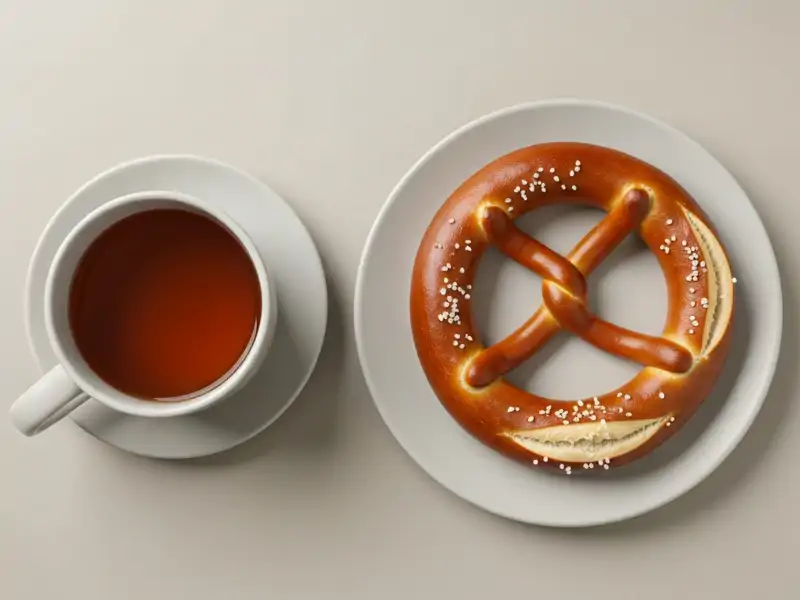
A 2020 study in Nutrients by Wang YJ et al. highlighted the clear link between dietary sodium intake and the risk of cardiovascular disease. High sodium isn't just about feeling bloated; it's a serious health concern. Jake will demolish an entire bag of these, then wonder why he's so thirsty later. I prefer to stick to the smaller packs, or even just half a pretzel, for portion control. Sometimes I'll share one with Jake, and still find myself reaching for water all afternoon.
Surprising Findings: The Chain with the Lowest Sodium Content
You might expect a dedicated pretzel chain to dominate the sodium charts. However, my digging revealed that the chain with the lowest standard soft pretzel sodium content isn't a dedicated pretzel shop at all. It's Bake My Day, a general bakery chain.
Their "Artisan Plain" pretzel, at 390 calories for a 140g serving, still packs a punch in carbs and calories, but it comes in at 650mg of sodium. This is considerably lower than the other dedicated pretzel chains. Why the difference? It comes down to their baking process and, a main reason, a less heavy hand with the coarse salt. They market it as "less traditional, more palatable," which I translate to "they didn't dump half a salt shaker on it."
This shows that pretzels don't have to be sodium bombs. It's a choice made by the manufacturer. If you're craving a soft pretzel, seeking out a bakery that offers a less aggressively salted option, or even asking for one with less salt, can make a significant difference. You might also find these options made with whole grain flour, which would offer more fiber, a nutrient often lacking in typical soft pretzels. For more on navigating sneaky "healthy" foods, check out Fiber Frenzy: Do High-Fiber Granola Bars Deliver or Deceive? Morgan Harlan Compares Brands, Crunches Numbers.
Here's the key: you have to be vigilant. Just because something is a "pretzel" doesn't mean it's all the same. Don't fall for the idea that pretzels are automatically "better" than other snacks. Some comparisons show a plain soft pretzel can have similar calorie counts to a standard bagel, but often with less protein and more sodium. And don't even get me started on the cheese dips or sweet glazes, which add hundreds more calories, grams of fat, and sugar.
The next time you're craving that chewy, salty snack, take an extra second. Check the nutrition facts. Choose wisely. Your blood pressure (and your body) will thank you.